How Sled Dog DNA Is Rewriting Arctic History
- Feb 16
- 2 min read
Updated: Jun 23
Student summary by Elizabeth Li
Original Source: Jake Buehler, Science News, July 10, 2025
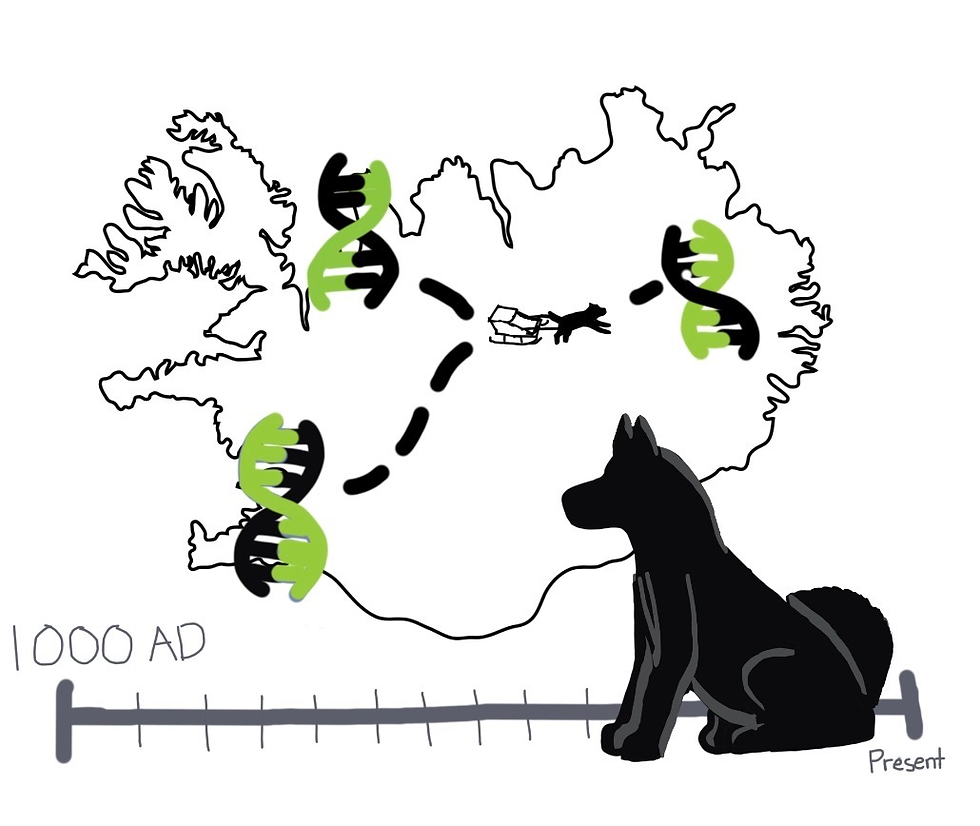
Image created by Elizabeth Li
Abstract
Background:
Dogs have shared a close bond with humans for over 20,000 years. When humans crossed a land bridge into the Americas, sled dogs were there to help them. Now, a population of large, thick-furred Arctic sled dogs, Qimmit (singular Qimmeq), is declining, with the population dropping to about 13,000 individuals in less than two decades. The culture of the Inuit people is closely connected to these dogs, as they have pulled sleds for the Inuit for centuries.
Objective:
Anders Johannes Hansen, an evolutionary geneticist at the University of Copenhagen, and his colleagues wanted to establish a genetic baseline for the population, which might help future conservation efforts.
Method:
They sampled genomes from 92 Qimmit, with some sampled across Greenland and others taken from museum collections dating back almost 800 years. These genomes were then compared to other modern dog breeds and wild dogs.
Results:
They found that Qimmit had limited interbreeding with European breeds, matching how they were isolated for a long time. The dogs also fell into four genetic groups that matched Inuit cultural regions, showing that the Qimmeq had a strong relationship with the humans in Greenland. The data revealed that modern Qimmit share a common ancestor from around 1,000 years ago. This suggests that sled dogs arrived in Greenland around that time, pushing back previous estimates by about 200 years. The Qimmeq were also found to be closely related to a 3,700-year-old Alaskan dog, suggesting that Inuit ancestors migrated rapidly across the Arctic. The genomes also showed that Qimmeq had low genetic diversity but limited inbreeding. Most modern inbred dogs tend to have substantial health problems, but these sled dogs showed fewer signs of those issues.
Conclusion:
This research could help protect Greenland's sled dogs from extinction. It would make conservation efforts easier by aiding relocation and protection. This information also helps us better understand the early history of Arctic peoples.