


Marine Expedition Discovers 31 new Species using Advanced Technology Student Summary
- 7 days ago
- 2 min read
Student Summary By Jayden Ahn
Original Source: Jonathan Watts, The Guardian, June 26, 2026 https://www.theguardian.com/environment/2026/jun/26/marine-expedition-uncovers-31-new-species-two-weeks-brazil
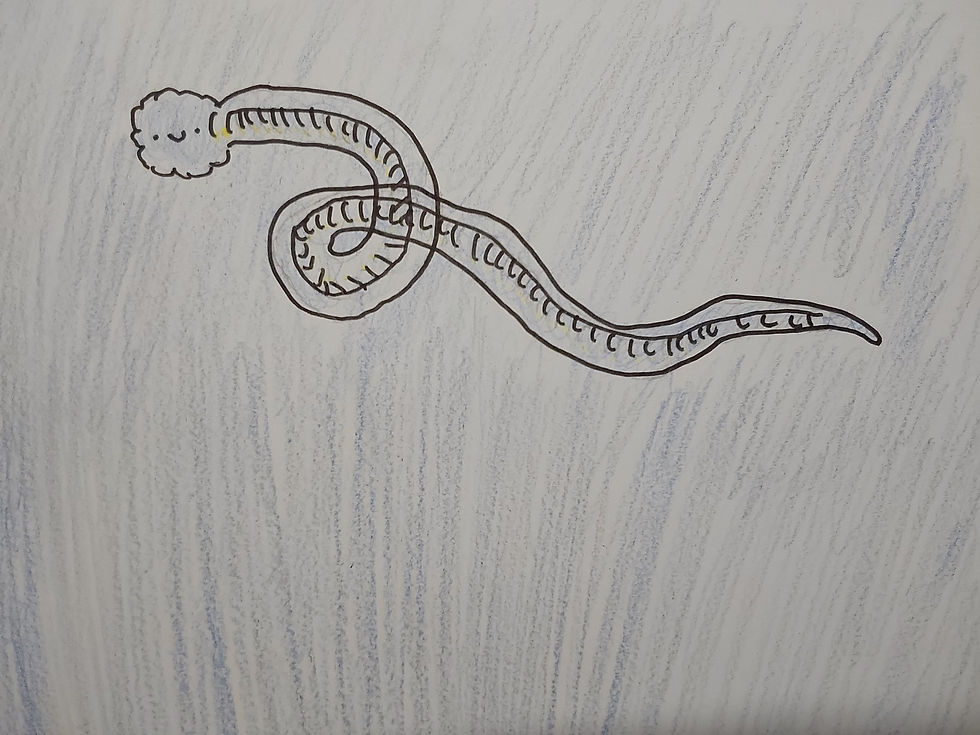
Image drawn by Jayden Ahn
Abstract
Background: The mid-waters of the ocean (the area between the seafloor and the sunlit layer near the surface, or also an area of the ocean where sunlight is not visible), it is one of the least explored places on Earth, but still scientists found new species using advanced technology.
Objective: Marine biologists from all over the world had one mission and one goal, it was to explore the depths and try to see if new species could be uncovered using advanced deep sea technology.
Method: The group of scientists conducted a two week research expedition in a vessel called the "Falkor (too)." Thanks to engineers, they were able to use advanced technology such as a new microscope called the "Squid," laser imaging, Remotely Operated Vehicles (ROVs), and other technology that helped them observe these new species.
Results: The two week research expedition was a success and the scientists were able to uncover new species such as an amphipod, a type a crustacean related to crabs and lobsters, a gossamer worm (a light marine worm), they also found nine jellyfish, seven siphonophores, seven comb jellies, four larvaceans, and two rhizarians. They were able to get samples from the species and studied them under special microscopes. What surprises people the most is that this was all done in two weeks using the most advanced technology in the world. Think about what humans can do in say 20 years, hundreds of species could be identified in 2 weeks.
Conclusion: The expedition was a success, but this is only a tiny bit of what the world has for us. There are millions of unknown species out there, and there are still many regions and places to explore. Imagine what else there is to be discovered, who knows maybe there could be something interesting for scientists in the future.


