


Island Gigantism in Birds
- Jul 1
- 2 min read
Student Summary by Elizabeth Li
Original Source: University of Birmingham, SciTechDaily, June 18, 2026
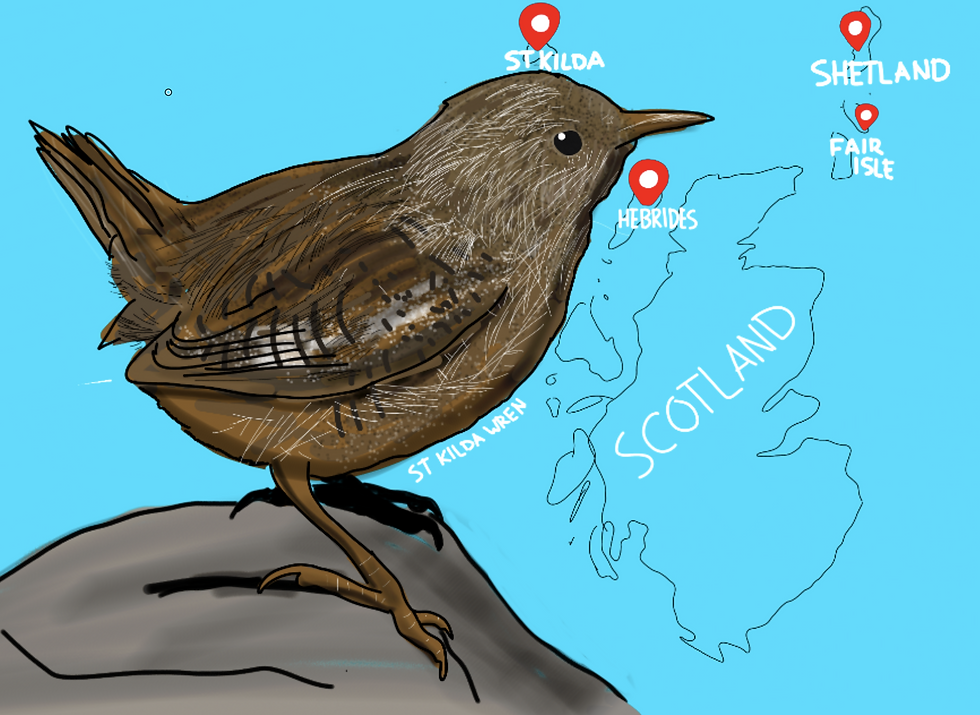
Image created by Elizabeth Li
Abstract
Background:
A common evolutionary pattern found in species of animals isolated on islands for prolonged periods of time is a change in body size. This pattern is sometimes called the “island rule” or island gigantism, and it belongs to a broader set of changes known as “island syndromes,” where island isolation leads to significant alterations in size and shape. Scientists are researching populations affected by this change to better understand the effects of isolation on evolution.
Objective:
A study led by researchers at the University of Birmingham aimed to find out whether island isolation truly had an effect on body size over time, and if that were true, what environmental factors of the islands impacted the evolution of these creatures. To determine a pattern, the scientists wanted to compare island species to their mainland counterparts as well as their habitats and environments.
Method:
Scientists studied subspecies of wrens from Shetland, Fair Isle, the Outer Hebrides, and St Kilda – each with noticeable differences from wrens found in Europe and Great Britain. These populations were all geographically separated from each other on similar island environments. To investigate this pattern, researchers analyzed body measurements, recordings of their songs, and whole genome sequences.
Results:
The team found that the wrens on the Scottish islands were consistently larger than mainland wrens. A typical wren from England weighs about 7 to 10 grams, while wrens on St Kilda weigh about 13 to 16 grams, meaning the largest St Kilda birds are more than twice the size of the smallest mainland wrens. These results were measured from several individual island populations, suggesting a consistent pattern in island versus mainland evolution. Wrens on the Shetland and St Kilda islands were physically very similar; however, they evolved to this point through very different genetic paths. The research suggests that each subspecies likely originated from the same group of mainland wrens. Although scientists still aren’t completely sure what causes island gigantism, some factors such as isolation and fewer predators are believed to drive larger body size and other similar evolutionary changes.
Conclusion:
These findings add to the evidence for the island rule in animal populations and show how isolation can drive evolutionary changes in island populations. Understanding these patterns in nature and evolution can help scientists better explain how isolation and other environmental factors can influence how a species evolves, however researchers note the exact mechanisms behind island gigantism are still not fully understood.


