Hummingbirds Living in a Hive Found for the First Time
- Feb 14
- 1 min read
Updated: Jun 23
Student summary by Olivia Hwang
Original Source: Rachel Nuwer, The New York Times, March 4th 2025
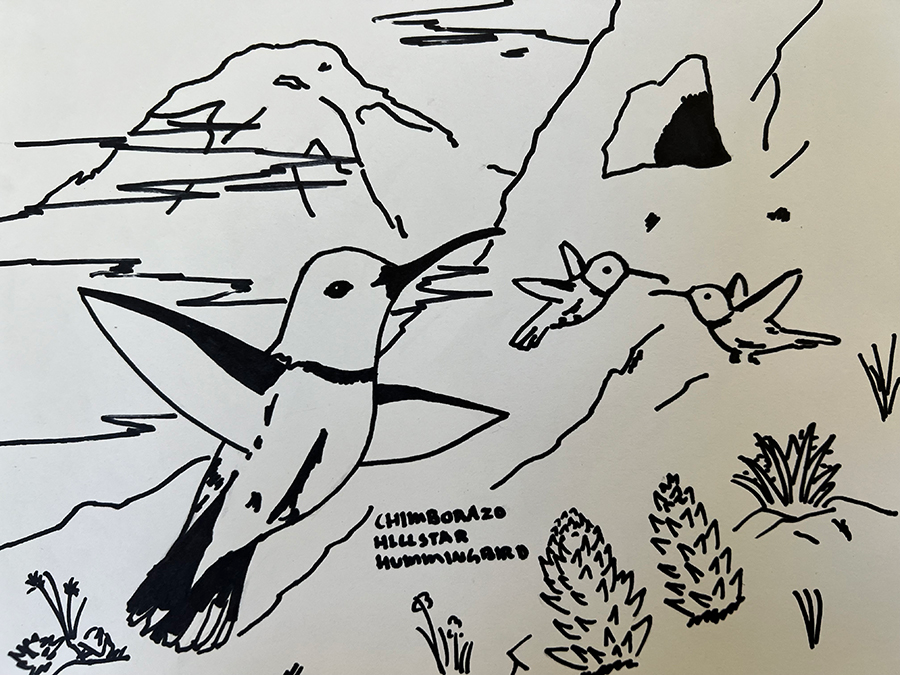
Image created by Olivia Hwang
Abstract
Background:
In the high mountains of Ecuador, ornithologist and birding guide Gustavo Canas-Valle discovered a cave containing a group of Chimborazo hillstar hummingbirds — a shocking sight, as hummingbirds are known to be one of the most territorial species of birds.
Objective:
Researchers wanted to further understand the factors causing the hummingbirds to roost and nest together. Additionally, they wanted to clarify whether the hummingbirds’ behavior could be classified as colonial.
Method:
In order to understand the hummingbirds’ behavior, Gustavo Canas-Valle explored nearby areas, eventually examining drainage pipes with the help of Juan Luis Bouzat. Other researchers also studied the hummingbirds’ behavior. Behavioral ecologist Charles Brown pointed out that there was no evidence proving colonial behavior. However, Gustavo Cañas-Valle noted that he saw groups of hummingbirds leaving and entering the cave.
Results:
While examining the drainage pipes, they found that a higher percentage of the hummingbirds chose to aggregate rather than nest in the pipes, which presented conditions similar to the cave. Gustavo Canas-Valle and Juan Luis Bouzat suggested that the hummingbirds' behavior may be influenced by environmental conditions, causing them to adapt and become more social. Charles Brown and Gustavo Canas-Valle agreed that more research is needed.
Conclusion:
This is the first documented observation of Chimborazo hillstar hummingbirds roosting together in a cave. This discovery could lead researchers to uncover more about hummingbird behavior.